Come a little closer to the stove.
Twelve winter evenings in a village of the Russian north, and one old woman of the forest. The Hut on Chicken Legs, the story of Baba Yaga, is the first book of Twelve Nights by the Stove.
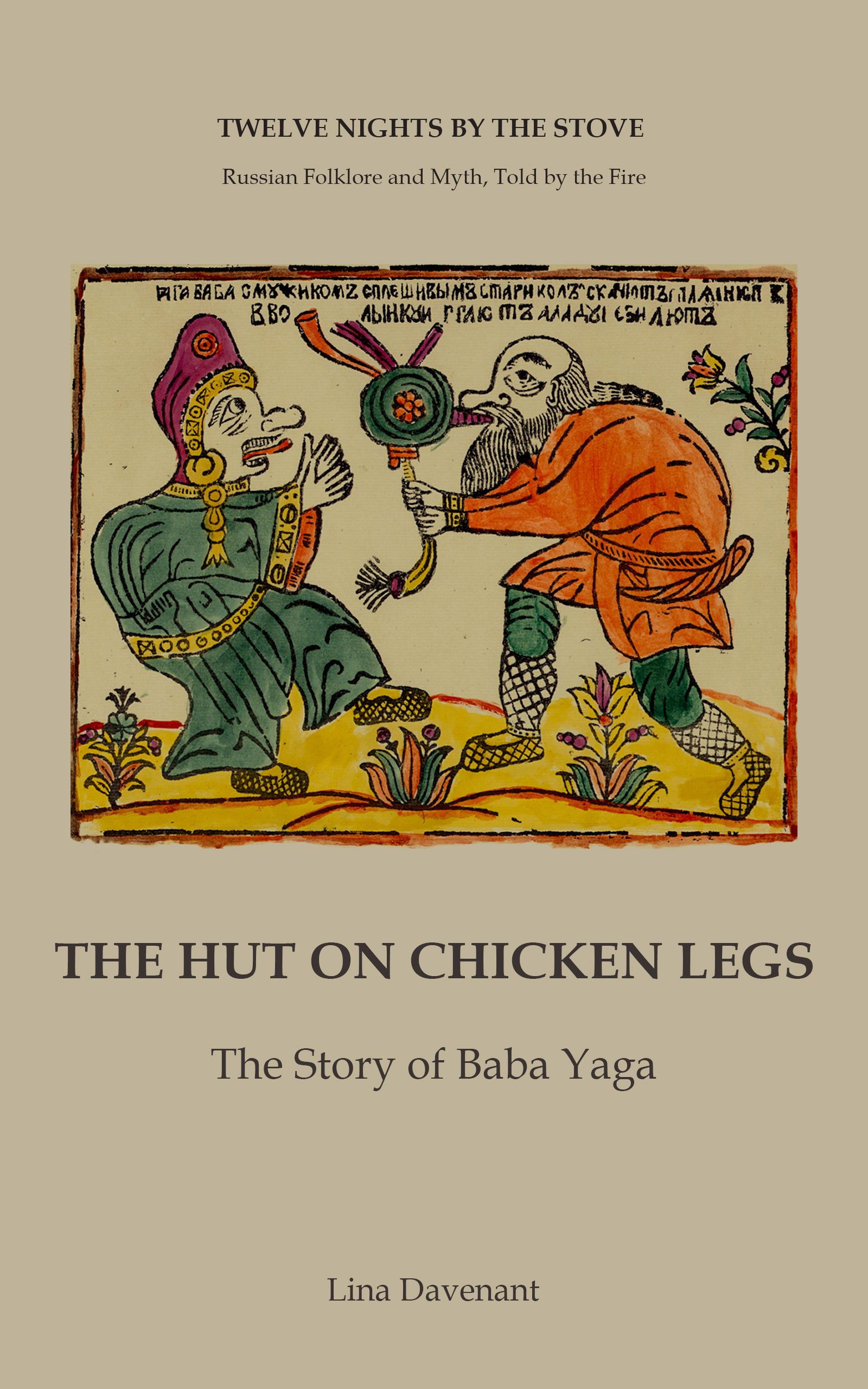
The Hut on Chicken Legs
The Story of Baba Yaga. Book One of Twelve Nights by the Stove: Russian Folklore and Myth, Told by the Fire
Winter, 1880. In Rodniki, a village deep in the forests of the Russian north, the twelve holy nights between Christmas and Epiphany have begun. Work has stopped. Mummers in masks and animal skins go from house to house, girls pour wax and look into mirrors to see their future husbands, and in Avdotya’s house, by the great whitewashed stove, the family gathers every evening to talk about the old woman of the forest.
Baba Yaga. She lives in a hut that turns on chicken legs, flies in a mortar and sweeps away her tracks with a broom. She eats children, or helps them, depending on the tale and on the child.
Over twelve evenings, a grandmother, an old soldier, a village midwife and a travelling pedlar tell the tales they know. Between the tales, a present-day narrator steps out of the village to follow Baba Yaga through two hundred years of scholarship, art and imagination: why her hut stands on chicken legs, why the folklorist Vladimir Propp saw her as the keeper of the border between the living and the dead, how an old woodcut of her fighting a crocodile may have mocked Peter the Great, and how Bilibin, Vasnetsov and Mussorgsky gave her a face and a voice.
The village is invented. Everything else is real. Wherever something is only guessed, you will be told so.
Read the opening
The First Evening: The Old Woman in the Forest
Come a little closer to the stove. No, closer than that. The draught from the door finds everyone in the end, and on a night like this it has come a very long way to find you.
Let me tell you about a village. You will not find it on any map, though there were thousands like it once, and a few of them are still there if you know which road to take and do not mind the mud. It is called Rodniki, which means “the springs”, after the cold springs that rise at the foot of its hill and never freeze, not even in the hardest January, so that on the coldest mornings a thin mist stands over them like breath. Above the springs runs one crooked street of log houses on a low rise of dry ground, with the marsh on one side and the forest on the other, and a small wooden church at the end of the street whose bell, on a still day, can be heard as far as the second bend of the river. We shall spend a good many winters there together, you and I. Tonight it is the winter of 1880, or thereabouts, and it is very cold.
Let us go into the third house from the church. Mind the step; it is higher than you think, because the house stands on a tall ground floor where the animals and the winter hay are kept, and the warmth of the cow comes up through the boards. The walls of the living room are dark with a century of smoke and still smell faintly of resin when the stove is hot. The great white stove takes up nearly a quarter of the room. It is a bed, a kitchen, a bathhouse at a pinch, and a place to dry felt boots, and on its warm ledge an old man called Prokhor is asleep, or pretending to be. In the far corner, diagonally across from the stove, a small lamp burns in front of the icon, and its light is the only thing in the room that does not move.
The spinning wheels have been pushed against the wall with their distaffs bare. In Rodniki nobody spins in the evenings of Svyatki; it is not a season for work, and there are old women who will tell you that thread spun on these nights brings no good to anyone who wears it. A birch log settles in the stove with a small, contented sound. The window has frozen over in ferns and feathers, so that the moon, which is nearly full, comes through only as a kind of pale suggestion on the floorboards.
It is the second evening of Svyatki, the holy twelve days between Christmas and the Blessing of the Waters at Epiphany, and everyone knows that on these nights the ordinary rules are a little loose at the seams. The unclean spirits are said to walk about freely until the water is blessed. It is the best time of the whole year for finding out what is going to happen to you.
The girls have been finding out all evening. Earlier they were out in the yard in their shawls, throwing their felt boots over the gate one after another and running out into the lane to see which way each toe was pointing, because that is the road your husband will come by. Nastya’s boot landed in a snowdrift pointing straight at the marsh, and there was a good deal of laughter about that, because nobody lives in the marsh, or nobody you would want to marry.
The evening goes on in the book, with a wax fortune, a boy carved from lime-wood, and an old man on the stove who is not as asleep as he looks.
Twelve Nights by the Stove
Every book is one winter in Rodniki: twelve evenings of Svyatki, the nights from Christmas to Epiphany when Russian households told frightening stories and read their fortunes. The books take turns. One gives a whole winter to a single figure; the next follows a theme through the village, with many figures passing through.
- 1The Hut on Chicken LegsBaba YagaOut now
- 2The Turning YearThe village calendarComing next
- 3The Girls in the RyeThe rusalka
- 4The Gods Who May Not Have BeenThe pagan pantheon
- 5The Master of the HouseThe domovoi
- 6Beyond the Kalinov BridgeDeath and the other world
- 7The Frost Who Came for ChristmasDed Moroz
- 8Words Against the DarkWitches and charms
- 9The Lord of the ForestThe leshy
- 10The Mighty MenHeroes and byliny
- 11The ThundererPerun and St Elijah
- 12Feathers of FireMarvels and beasts
Titles after Book One are working titles and may change.
Book Two: The Turning Year
The same house, in 1881. Avdotya, Prokhor, Nastya and little Fedya come back to the stove, and this time the evenings follow the whole village year, from the Svyatki fortunes to Maslenitsa, the birches of Trinity, Kupala night and the harvest, all the way round to Pokrov.
Also by Lina Davenant
The Lady of Tears Duet
Adventure romance in 1920s Mesopotamia. A Russian émigrée translator talks her way onto an archaeological dig with a forged letter of recommendation, and finds the desert keeping older secrets than hers.
- A Lament in Clay
- A Silence in Stone
In preparation. Letters from Rodniki will tell you when the first one is out.
About Lina
Lina Davenant grew up with Russian fairy tales, the kind told at bedtime and the kind that were never meant for children. She reads in Russian and English, and she writes about old stories and the places they come from.
Twelve Nights by the Stove is her series of fireside books on Russian folklore and myth: one northern village, twelve winter evenings, and everything the storytellers, collectors, scholars and painters have said about the creatures of the Russian forest. She also writes adventure romance set among the archaeological digs of the 1920s.
She draws, too, and a few of the pictures in her books are her own. She lives in Europe.
Letters from Rodniki
A short letter when a new book is out, and now and then a story from the village that did not fit in a book. Nothing else, and you can leave whenever you like.
Write to Lina
For readers, reviewers, booksellers and anyone with a story about Baba Yaga:
hello@linadavenant.com